



Every winter, gull roosts along the coast hold a few birds that look almost right and not quite right. The head is a shade too dark, the bill too heavy, and when the bird stretches a wing the underwing flashes clean white. Chances are you have found a Mediterranean Gull. The species has spread steadily north and west over recent decades, and in many coastal areas it is now a regular winter bird rather than a rarity. Learning to pick one out is mostly a matter of knowing which features to check, and in what order.
Why winter birds trip people up
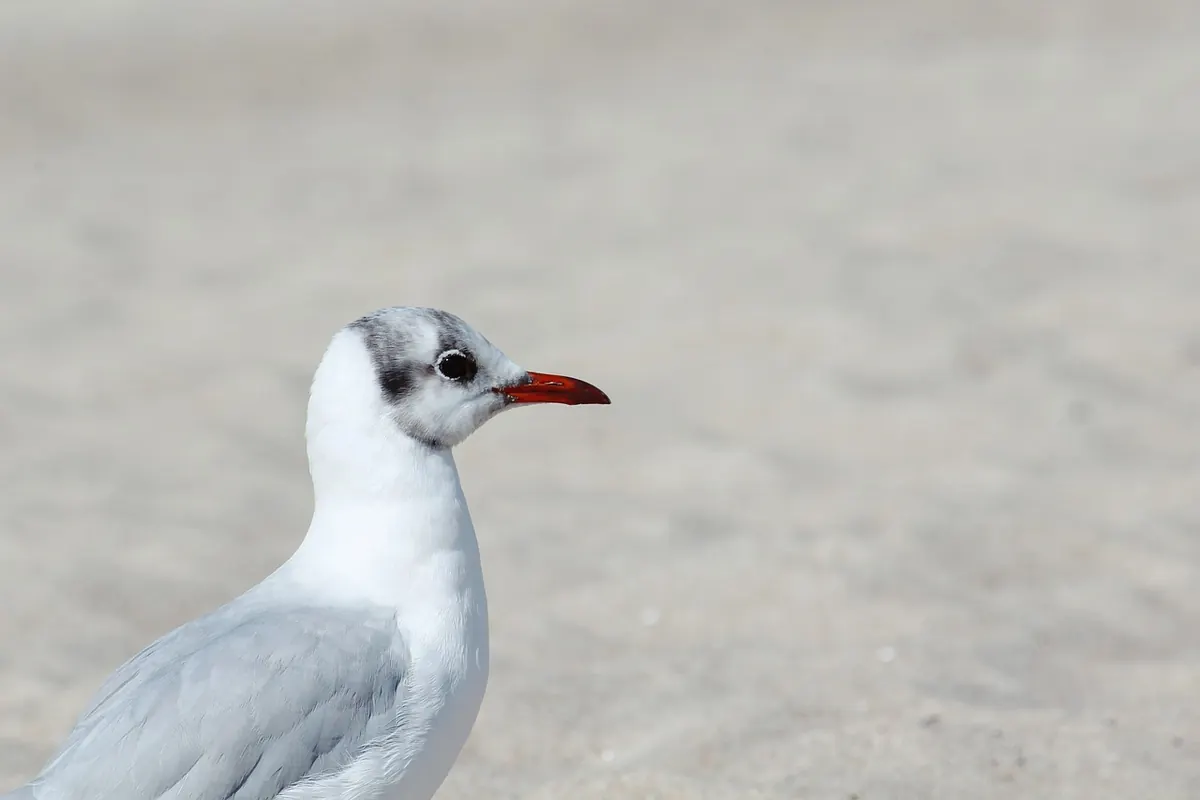
The first surprise for beginners is that Mediterranean Gulls do not look like the field guide plate in December. The full jet-black hood belongs to the breeding season. Adults moult out of it in late summer, and through autumn and early winter the head is white with a dark smudge behind the eye. That smudge is not fixed, either. By January and February many birds have developed a broad grey-black wash over the face and hindcrown, and a few look as if they are growing the hood back early. Birds seen in February can appear half-hooded and thoroughly confusing.
Then there are the young birds. A first-winter Mediterranean Gull is brown, masked and entirely unlike the neat white adults standing beside it. Add flat winter light, a roost three hundred metres away, and a few hundred Black-headed Gulls shifting about, and it is easy to see why this species gets overlooked.
The four marks to check first
For adults and near-adults, most identifications come down to a short list. Run through these before you start worrying about subtle tones of grey.
- The underwing. Adult Mediterranean Gulls have a wholly white underwing. Black-headed Gulls show a dark grey-brown wash across the underwing coverts, which is obvious even in poor light. This is the single most useful mark in a roost, because birds stretch and flap constantly.
- The wingtip. Adult Mediterranean Gulls have a solid black wedge at the wingtip with no white mirror. Black-headed Gulls show a clear white flash on the outer wing in flight.
- The trailing edge. A broad white band along the rear edge of the wing, contrasting sharply with the black tip and the grey upperwing.
- The build. Heavier than a Black-headed Gull, longer-billed, longer-legged, chestier. It reads as a small, sturdy gull rather than a delicate one.
If the underwing is dark, you are looking at a Black-headed Gull and can move on. It really is that quick once your eye is in.
Head, bill and legs in winter light
The bill of an adult is deep blood-red in summer and dulls through winter, often picking up a dark smudge or a darker tip. It stays a dark, rich red rather than turning orange, and it is noticeably longer and heavier than the neat, fine bill of a Black-headed Gull. Black-headed Gulls in winter usually show an orange-red bill with a clean dark band near the tip; Mediterranean Gulls show a heavier dark red bill with a muddier, less tidy dark area.
Legs follow the same pattern. Expect dark red to almost blackish-red, never the bright orange-red of a winter Black-headed Gull. On a bird standing in shallow water the leg colour can be hard to judge, so wait for it to walk.
The eye is worth close attention. Adult Mediterranean Gulls have a dark eye, often framed by small white crescents above and below that give a wide-eyed, slightly surprised expression. In bright low sunshine these crescents can be the feature that makes you lift your binoculars. They are also lost as soon as the dark face smudging spreads, which is part of why late-winter birds look so different from November ones.
Field tip: judge bill and leg colour only on birds in direct light. Backlit gulls at a roost can look dark-legged and dark-billed whatever the species.
Separating them from similar coastal gulls
Black-headed Gull
This is the comparison that matters. Black-headed Gulls are smaller, finer-billed, paler-winged and, in winter, show only a small round ear spot rather than a smeared dark patch across the face. In flight the dark underwing and white outer-wing flash are decisive. Voice helps too: Black-headed Gulls chatter and laugh, while Mediterranean Gulls give a nasal, drawn-out mewing call that carries well across an estuary.
Common Gull
Common Gulls are also pale-mantled and dark-eyed, but they have a yellowish-green bill with a distinct dark band, a rounder head, and obvious white mirrors in the black wingtip. They lack the dark face smudge entirely and their underwing is pale but not the crisp, clean white of a Mediterranean Gull.
Laughing and Ring-billed Gulls
Readers on the far side of the Atlantic have two more candidates. Winter Laughing Gulls keep a dark bill and show grey smudging down the hindneck rather than a neat ear patch, and Ring-billed Gulls are larger, yellow-billed and pale-eyed. In both cases, the combination of structure, bill colour and underwing pattern will sort them out.
Age and plumage variation
Mediterranean Gulls take three years to reach full adult plumage, so a winter flock can hold birds at several stages. Learn these three and you will stop dismissing brown birds as Black-headed Gulls.
First-winter
Brownish-grey above with pale feather fringes, a brown wash over the head, a dark ear patch and a dark band across the hindneck. The bill is blackish and the tail shows a dark band. These birds often look small, soft and slightly hooded, and they feed more actively than adults. Their underwing is not clean white, so the roost trick does not work on them.
Second-winter
A patchwork. Grey feathers appear across the mantle and upperwing alongside retained brown coverts, the head shows a reduced dark mask, and the bill begins to turn red or orange-red with a dark tip. Some birds look almost adult by their second winter, with only a few brown coverts and a dull bill betraying them; others are much browner.
Adults
Clean grey above, white below, black wingtip, white trailing edge, white tail. The variable part is the head: from almost white with a soft ear smudge in November, to a broad dark face and hindcrown by late winter as the breeding hood starts to grow. Birds in mid-February can look startlingly dark-headed, which is normal and not a sign of anything unusual.
Voice, behaviour and finding your own birds
Mediterranean Gulls in winter are social, and they rarely turn up alone. Look for them in Black-headed Gull flocks on estuaries, coastal fields, saltmarsh and beaches, and especially at afternoon roosts where birds gather to preen before dark. Scan the flock rather than the sky: birds on the ground reveal structure and bill colour, and every so often one will stretch a wing and show you the underwing.
In flight, note the longer wing action and heavier body compared with Black-headed Gulls. They also tend to feed a little more deliberately, picking at the surface rather than snatching. Listen for that nasal mew — it is often the first thing that makes you turn your head.
A short field routine
Next time you are standing over a winter roost, work through this in order.
- Scan for birds with noticeably heavier bills and chunkier bodies, then check those first.
- Watch for wing stretches and flapping. White underwing plus solid black wingtip equals adult Mediterranean Gull.
- On standing birds, confirm dark red bill, dark red legs and white eye crescents in good light.
- Check the head pattern against the nearest Black-headed Gulls: smeared and broad versus a small neat ear spot.
- For brown birds, look for a dark ear patch, dark hindneck band and blackish bill rather than dismissing them.
- Note the time of year and the extent of dark on the head, so you build a picture of how the plumage shifts through the winter.
Give it a season of regular visits and the search becomes instinctive: a scan of the flock, a pause at one bird, a second look at the underwing, and you have your answer.
Photo: TanteTati / Pixabay