

The cold arrives first — a raw, damp chill that comes off the water and finds the gap between your collar and your hat. Then the light changes, the mudflats start to show their ridgelines, and the lagoon fills with sound: whistling wigeon, the thin call of a curlew, the splash of something large landing out of sight. Winter is the season when these shallow brackish waters do exactly what they were made for. Birds that bred from Scandinavia to Siberia are here to sit out the cold, and they gather in numbers you will not see in May.
It is also the season that asks more of the visitor. Days are short, the wind is rarely kind, and the ground you walk on can be softer and wetter than it looks. A good winter visit is a small piece of planning — tide table, weather window, the right layers — followed by a long, quiet, low-effort watch. Here is how to get that balance right.
What Winter Does to a Lagoon
A northern Italian lagoon is a working landscape: shallow water, channels dredged by tides, low saltmarsh islands, mudflats that appear and disappear twice a day, reedbeds at the freshwater edge, and often the earth banks of old fishing valleys. In summer it is busy with boats, bathers and breeding birds. In winter it belongs to the water and to whatever has flown south to use it.
The change in behaviour matters more than the change in species list. Waterfowl stop defending territories and start feeding in loose, mobile flocks. Waders follow the tide instead of guarding nests. Reeds die back, which means you can see into places that would be a green wall in June. Distances shrink in another way too: every bird on the lagoon is now tuned to movement and sound, because everything is hunting something. Your approach is the whole game.
The Birds You Can Expect
Ducks, grebes and open water
Eurasian Wigeon are usually the soundtrack — a soft, falling whistle drifting across the water before you have found a single bird. Look for them grazing on saltmarsh edges at low tide, often alongside Gadwall and Eurasian Teal. Northern Pintail and Common Shelduck favour the wider, shallower pans; Common Pochard and Tufted Duck sit further out in deeper water, with Greater Scaup on the more open coastal lagoons. In channels and around mussel beds, watch for Red-breasted Merganser and the low, rapid flight of a Great Crested Grebe. Wintering Great Crested, Black-necked and Little Grebes all fish here, and a calm morning makes them easy to separate at range by size, bill and the shape of the head.
Distant duck flocks are the classic winter identification trap. Do not try to name every bird. Work on silhouettes, feeding posture and flight pattern first, then confirm with the scope when something lifts its head.
Waders, herons and the tide's edge
Waders concentrate on whatever strip of mud the tide has just uncovered or is about to cover. Expect Pied Avocet sweeping their bills side to side, Eurasian Curlew and Black-tailed Godwit probing deep, Spotted Redshank wading belly-deep while Common Redshank work the drier edge, and Dunlin and Grey Plover in tight, nervous groups. Common Snipe hide in wet grass and rushy margins rather than on open mud.
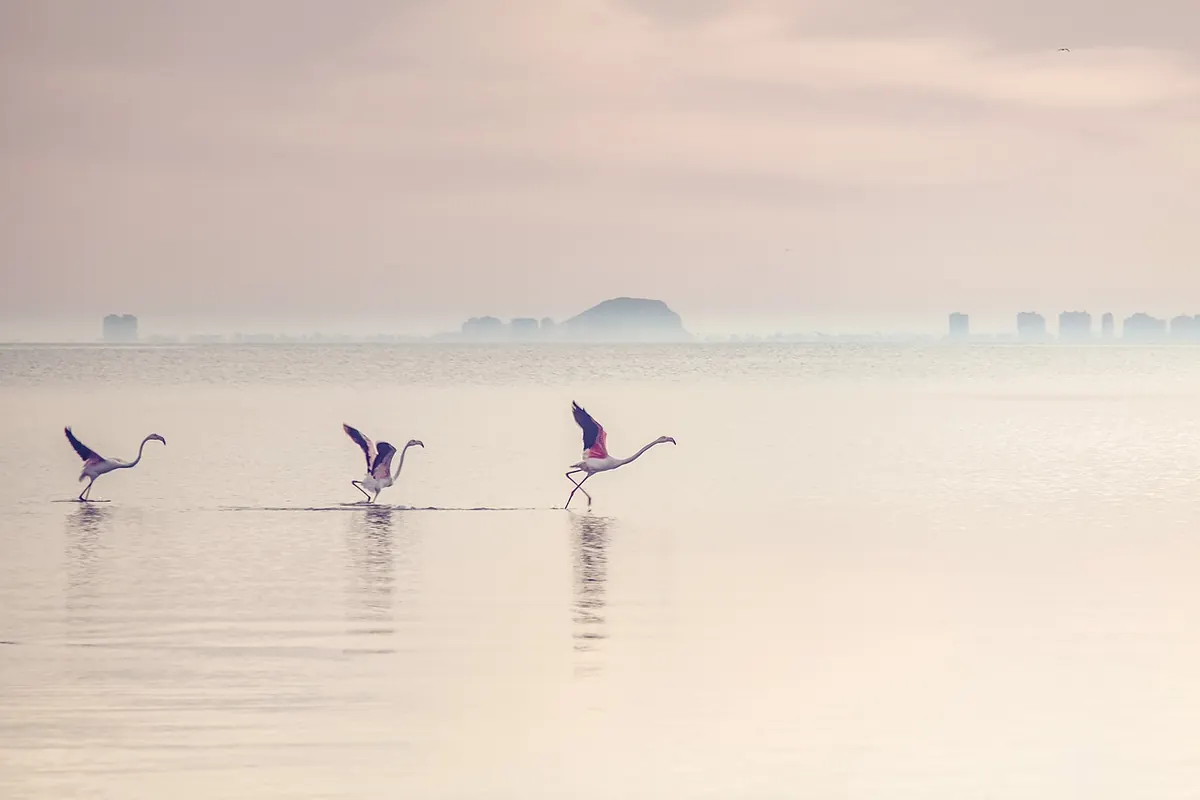
The larger birds are hard to miss: Grey Heron, Great White Egret and Little Egret standing in the shallows, Eurasian Spoonbill roosting in a huddle, and Greater Flamingo at sites such as Orbetello, the Po Delta and the Cagliari lagoons — pink shapes in grey light that still manage to look improbable.
Reedbeds and raptors
Reedbeds in winter are worth patience. Listen for Cetti's Warbler, then look for Bearded Reedling climbing stems in slow motion, Penduline Tits working the seed heads, Water Pipit on wet grass, and a Bluethroat flicking in the shade of a bank. Above the reeds, Marsh Harriers quarter low and slow; Hen Harriers come in to roost on cold afternoons, and a Peregrine on a distant post can empty a mudflat in seconds. In the north-east, pygmy cormorants gather in winter, often in the same channels as their larger relatives.
Choosing Your Days
Weather decides where the birds are, not just whether you enjoy yourself. On the northern Adriatic, a bora — the cold north-easterly — pushes water out of the lagoon and drives birds into sheltered channels and lee shores. A scirocco from the south-east does the opposite and can raise water levels sharply, which is exactly what produces acqua alta in Venice. Cold, clear air after a front often brings in harder-weather species from further north, and those are the mornings worth cancelling other plans for.
Wind direction should shape your route: find the bank with the wind at your back and the sun behind your shoulder, and the same flock that was a grey smudge becomes readable. Calm mornings are best for hearing and for spotting birds on the water; flat overcast light is underrated for scoping distant waders, because it kills the heat shimmer that ruins midday views in low winter sun. Give the middle of the day to travel and the two hours after dawn to watching.
Cold-Weather Gear That Actually Works
Winter birdwatching is a standing-still activity, so dress for the coldest version of the day rather than the walk to the hide. Layers beat bulk every time.
- Base layer: synthetic or merino, never cotton. A damp cotton shirt is the fastest route to a miserable afternoon.
- Mid layer: fleece or light down, plus a spare in the pack for the hour before dusk.
- Outer layer: windproof and waterproof shell, ideally with a hood that fits over a hat. Wind is a bigger problem than rain on a lagoon bank.
- Legs and feet: insulated boots or wellingtons with wool socks, and neoprene socks if you will be standing in cold water or on wet boards.
- Hands: thin gloves with fold-back fingers so you can focus and use a notebook; a hand warmer in a pocket is a genuine luxury.
- Head and neck: warm hat and a buff pulled up over the chin.
- Optics care: lens cloth, a dry bag for the binoculars in salt spray, and silica sachets in your pack.
- Day kit: flask, water, headtorch, tide table, paper map, and a phone kept warm and dry.
Wind, Tide and Mud: Staying Safe
Lagoons look harmless and are not quite. Three things deserve respect.
Tide. Check the tide table before you leave and again at the trailhead, and know how long it takes to walk back to a bank. Mudflats that were dry on your way out can be cut off within an hour, and channels fill from behind you as often as from the front. In the Venice Lagoon, tide forecasts are published daily and are worth reading properly rather than glancing at.
Mud. Lagoon mud can be thigh-deep and it holds. Never cross an unmarked mudflat alone, test every step where the surface looks firm, and carry a walking pole. If you do go in, do not fight it — spread your weight, get low, and work backwards towards firmer ground rather than forwards. Waders full of water are a serious hazard if you fall in a channel; a belt helps, and a lifejacket is sensible at exposed sites.
Wind and cold. Wind chill on an open bank is draining, and the early signs of hypothermia — clumsiness, poor judgement, unreasonable cold — arrive before you notice them. Plan a warm-up stop, carry a spare layer and a hot drink, and turn back early rather than late. Tell someone your route and expected return time; mobile coverage on remote lagoon edges is patchy.
One more thing to check before you go: hunting. Waterfowl hunting is permitted in many Italian wetland areas during the winter season, and regional calendars and local restrictions vary. Wear something visible on days when hunting is allowed nearby, keep to permitted paths and reserves, and check the rules for the specific site — many lagoons require permits or restrict access to marked routes.
Quiet Observation: How to Get Close Without Getting Close
The best winter views usually come from a bank, a hide, or a causeway where you never leave the path. Scan with binoculars first to find activity, then set up the scope and let the birds settle again. Move slowly and in a straight line; stops and starts read as stalking. Keep your profile low behind banks, avoid cresting a skyline, and never walk directly at a flock — angle across it instead, as if you were going somewhere else.
Time your watch with the tide. On rising water, birds are pushed off the mud and drift closer to the shore, which is the easiest way to get good views without pressing them. On the ebb, follow the water out and let the birds come to the newly exposed edge. Late afternoon is for roosts: watch them from a distance and well before dusk, and leave the birds undisturbed to settle. A notebook with counts, tide state and wind direction turns a pleasant walk into something you can compare year after year.
Practical Notes for a Winter Visit
Plan around two hours of good light rather than a full day, and be willing to move to a sheltered bank when the wind picks up. Take the tide table and the forecast seriously, dress in layers you can shed, and keep your bag light enough to walk a kilometre of wet path without regret. Bring a thermos, a notebook and a lens cloth, and leave the drone and the loud voice at home. Then find a bank with the wind behind you, sit low, and let the lagoon come to you — winter rewards the visitor who stays still.
Photo: Leolo212 / Pixabay